Lowell Girls
Picture this: the year is 1840, you’re a 15 year old girl who has spent her entire young life on her family’s farm when suddenly, your life path sends you on an adventure.
I’m assuming that’s what it must have felt like to be a teenage farm girl sent to work at the textile mills in Lowell, Pennsylvania in the mid-19th century. Lowell wouldn’t really be seen as “the big city” by today’s standards, but for a rural farm girl it certainly would be. It would also be the first time these girls ever lived away from their families, so the feeling must have been a mixture of fear and excitement.
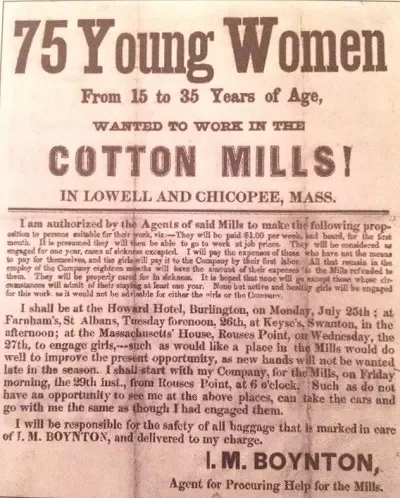
Lowell, Pennsylvania was established in the early 1820s, at a time when an agricultural economy was giving way to industrialization. Francis Cabot Lowell started the mill, and the town was established to house its workers. Those who lived there would live, work, and go to church in town allowing them to work longer hours. This became the standard during the 19th century, and you’ll find many old mill and mining towns once served this purpose.
By the 1840s, over 8,000 women and girls were living and working at the Lowell mill. These ladies became known as the Lowell girls. It was hard work—often 13 hours a day. Even so, it provided an escape from the monotony of farm life, which often involved grueling work. In addition to helping out with farm chores, girls were expected to help their mothers keep the home.
Working at the mills,they’d earn around $3 a week, which sounds like a small amount but was pretty sweet for the time. While they’d send most back to their families, they kept a little, providing financial independence unheard of for women at the time.
When the bosses eventually lowered their pay (because of course they did), the girls actually tried to fight back. Many girls went on strike and demanded their wages be restored, an effort one disgruntled manager called “an amazonian display.” Hell, yeah. In a way, these girls (who didn’t even have the right to vote) formed one of the country’s first workers unions.
Their efforts were eventually crushed by the mill owners. And in the later half of the 19th century they would see their jobs taken by the influx of immigrant men and boys willing to work horrid hours for pathetic pay. Even so, this was a first taste of independence for women in America, and it wouldn’t be the last ꩜